


DHOOP CHHANV/
GRADUATION PROJECT II
2026
Inspired by the shifting light and shadow cast by foliage across the UTM grounds, this direction translated fragmented forms, layered densities, and movement into abstract surfaces.
The resulting designs span different applications while remaining connected through a shared visual language of rhythm, texture, and abstraction.
Sponsored by VAYA Home, Universal Textile Mills


Overview
Guided by a combination of studio briefs and independent design explorations, the developments responded to various categories each requiring a distinct visual and technical approach.
The resulting designs were approached not as a single collection, but as a body of related developments; individual surfaces intended for different applications yet linked through a common sensibility.
X


Markmaking
The initial observations were translated into a series of ink mark-making studies, exploring lines, smudges, broken strokes, and dotted textures to capture the fragmented quality of light and shadow.
The mark-making process was deliberately open-ended, allowing the forms to move away from direct representation and towards a more abstract visual vocabulary.
Selected marks were then developed through small-scale iterations, exploring their potential across embroidery, sheers, jacquards, upholstery, and drapery.


Concepts
(expand for detail)

Design 01
Resha - Jacquard Sheer
This concept was developed from one of the markmaking
studies in which the abstraction and fluid
quality of the linear forms stood out as particularly
compelling.
The graphic quality of the strokes, along
with the sense of movement within the artwork,
made it a strong candidate for further development.


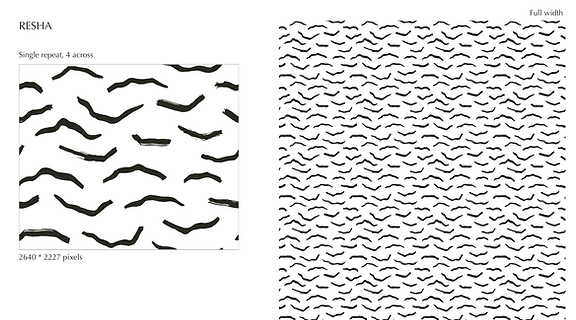
Care was taken to preserve the irregularity and texture of the original lines, ensuring that the translated design retained the expressive quality of the hand-painted artwork rather than becoming overly cleaned or mechanical.


Design 02
Dhaara - Jacquard Upholstery
The same design direction was also taken forward into upholstery in order to explore its potential at a larger scale. An initial trial was woven using the existing artwork; however, the result appeared visually too plain and lacked the depth needed for a more substantial furnishing surface.
The design was reworked by enlarging the scale and introducing greater spacing between the repeated elements, allowing the surface to feel more open and dynamic. At this stage, an ikat-like effect was suggested as a way of adding visual richness and softness to the design.


Design 03
Parat - Jacquard Sheer
Alongside the foliage-shadow explorations, the research
conducted on both international and domestic furnishing
brands revealed a recurring interest in brushstroke-led
abstract surfaces, particularly those that balanced
spontaneity with a strong graphic presence.
In response to this, one of the texture studies developed
during the mark-making stage was identified as a potential
direction for further exploration


The design was then translated into a jacquard file, however cleaning was kept to a minimum to retain the desired effect.
Multiple trials were undertaken to test the surface for buta
cutting. Parallelly, a simpler sheer was also sampled, but it was felt that the graphic effect of the buta cutting complimented the design better.

To further enrich the surface, the artwork was subsequently taken into Photoshop, put into repeat and an additional layer of texture was introduced to create greater visual depth and interest without
compromising the clarity of the woven form.


Design 04
Nukta - Jacquard Sheer
This design originated from a brief to explore the
possibility of developing a sheer surface featuring small
embroidered dotted motifs.
A number of visual trials and explorations were done to
understand how a delicate dotted arrangement might
function for an embroiderd sheer fabric.


A circular broken-dot motif was selected for further development for its simple yet contemporary character. However, the amount of trimming required for embroidery made the design less viable from a production and cost perspective, leading to its exploration as a jacquard sheer.
The motif was refined and slightly consolidated to ensure clarity within the weave structure. Scale variations were also tested, while maintaining the minimum 1.5 cm width required for successful weaving.


Design 05
Ahata - Embroidered sisal wallpaper
The scale and ornamental quality of the composition suggested a strong potential for wallcovering. With the reference of a cord embroidery technique, the design was manipulated and a new composition was developed, which was more graphic and better suited for a larger scale.


Mechanical embroidery required the artwork to conform to a precise repeat size, with repeat heights restricted to 40, 60 or 80 cm, and to be divisible by 90cm horizontally, the width of the sisal wallcovering base. Multiple compositions were explored.
Colour trials were manually embroidered onto different colours of the sisal base. Combinations of a wrapped multicolour cord and a 300 D viscose thread were chosen for each base, from which selected options were taken forward for sampling on the embroidery machine.


Design 06
Upal - Embroidered Drapery
A bold, abstract block-like composition from the mark-making studies was developed for VAYA Hues, with a focus on creating a modern yet economical design. Initial scattered and multi-scale arrangements were explored for embroidery, but the forms were refined after they felt too playful for the intended furnishing context.

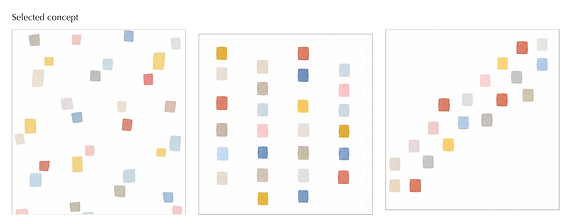


The forms were further abstracted into more organic shapes, with proportion and tonal colour used to create a contemporary feel.
A combination of TKT and Aari embroidery added subtle texture and depth, while a light, tonal palette kept the design suitable for drapery without becoming visually heavy.


Design 07
Kadi - Embroidered Drapery
This brief explored specialty chenille cords developed in-house, combining chenille with multicoloured TKT threads to create a more tactile and decorative embroidery element. Initial concepts were simplified to reduce cord usage and production costs while retaining the yarn’s visual appeal.


The final direction focused on clean, vertical compositions that allowed the cord to stand out without overwhelming the fabric. Small stabilising stitches were introduced to manage breaks caused by machine trimming, while increasing the scale reduced embroidery density and gave the design greater presence.


