


VIOLA/
IKKAT WEAVING
2025
Overview
A hands-on exploration within the technique of ikkat dyeing and weaving.
Understanding traditional methods and the language of the craft by doing it ourselves, under the guidance of recognised craftsmen to suggest and introduce new designs and motifs that push the limits of what is already being produced.
4 Week Textile Workshop led by Sri Murali Sir, Sri Shankar Sir


Ikkat, is a traditional resist dyeing technique where intricate motifs and patterns are dyed onto the yarns before weaving. It is a meticulous, labour-intensive process, yielding beautiful designs that are at once deliberate and naturally fluid.
The hallmark of Ikkat lies in its softly blurred edges and color striations, a visual signature of the dye bleeding slightly beyond its boundaries
Pattern and Colour trends Study

Chaotic Ditsy Prints / Flower Profusions / Busy Floral Mixtures / Hand Painted Flower Gardens / Free Spirited Blooms / Colourful Flower Bursts / Impressionist Garden / Lush Florals / Cottage Garden Flowers

Moody Blue Tropicals / Artsy Florals / Biro Sketches / Textural Geometrics / Indigo Florals / Scenic Doorways / Postcard Destinations

Aqua Fusion / Playful Geometrics / Soft Edged Patterns / Watery Checks & Stripes / Tie Dye Geometric Plays / Structural Bleed Patterns / Soft Focus / Subtle But Bold / Playful Colour Usage
Patternbank premiere Vision Spring/Summer 26

The designs were adapted to fit in with the aesthetics and design language of the brand Injiri. Their visual language draws from folk and nomadic traditions, especially the clothing styles, silhouettes, and colour palettes of Rajasthan and Gujarat.
For their home textiles, collections are often inspired by traditional architecture and living environments. Their design is about simplicity and restraint, working within the “limitations” of hand-loom techniques to create honest, understated pieces.


I chose to derive inspiration from pansies, a flower that frequently shows up in my work. Scientifically known as Viola tricolor var. hortensis, its derived from the French word "pensée", meaning "thought" or "remembrance".
Pansies have long been associated with, thoughtfulness, remembrance of loved ones, love in idleness (from Shakespearean lore), free-thinking and reflection
The Inspiration
In the language of flowers (floriography), giving someone a pansy traditionally conveys the message:
“You are in my thoughts.”
Motif and repeat trials


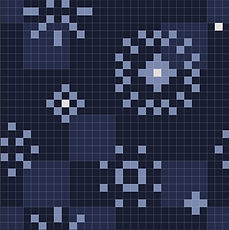


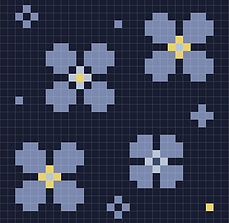
Final Surfaces
4*4 inches


The warp length was set to be 4 meters long and 12 inches wide, with each repeat being 14 inches long.


Process


The yarns are warped and then stretched on a frame, into 30 sections, ready for the tying process


The yarns are tightly wrapped in rubber strips and thread to resist the dye.


The design is marked pixel by pixel, on each section


This is done for each colour, its tied and untied in order of the lightest to darkest for the whole warp to protect each colour while dyeing


The yarns are then precisely set on the warp as not to disturb the design and manage equal tension throughout the warp.


Multiple wefts and weft orders were tried, where a combination of cotton and zari brought out the colours and effects of the design best.


